Hevy is a workout tracker for the gym. You log every set as you go, the weight and reps, and it remembers everything so you know what to beat next time.
I started using it in April 2026 to build a proper routine. By July I had 95 workouts logged, and my split, weights and rest times were all in my head. I kept going to the gym, but I stopped opening the app. Logging every set felt like too much effort, and my split had grown to five routines when the free plan only saves four.
I work in product, so an app I liked losing me this quietly was hard to leave alone. I made two new accounts to go through onboarding again, took about 70 screenshots, and read a lot of reviews to figure out whether it was just me. Turns out plenty of people drift off the same way. Hevy is brilliant at building a gym habit, but once the habit is built, it gives back less while still asking for the same effort every set.
What I'd build next:
Faster logging for routines you already know, including logging by voice
Plateau alerts and milestone stories that give experienced lifters something back
Gym leaderboards that reward showing up, and a check-in for people who stop logging
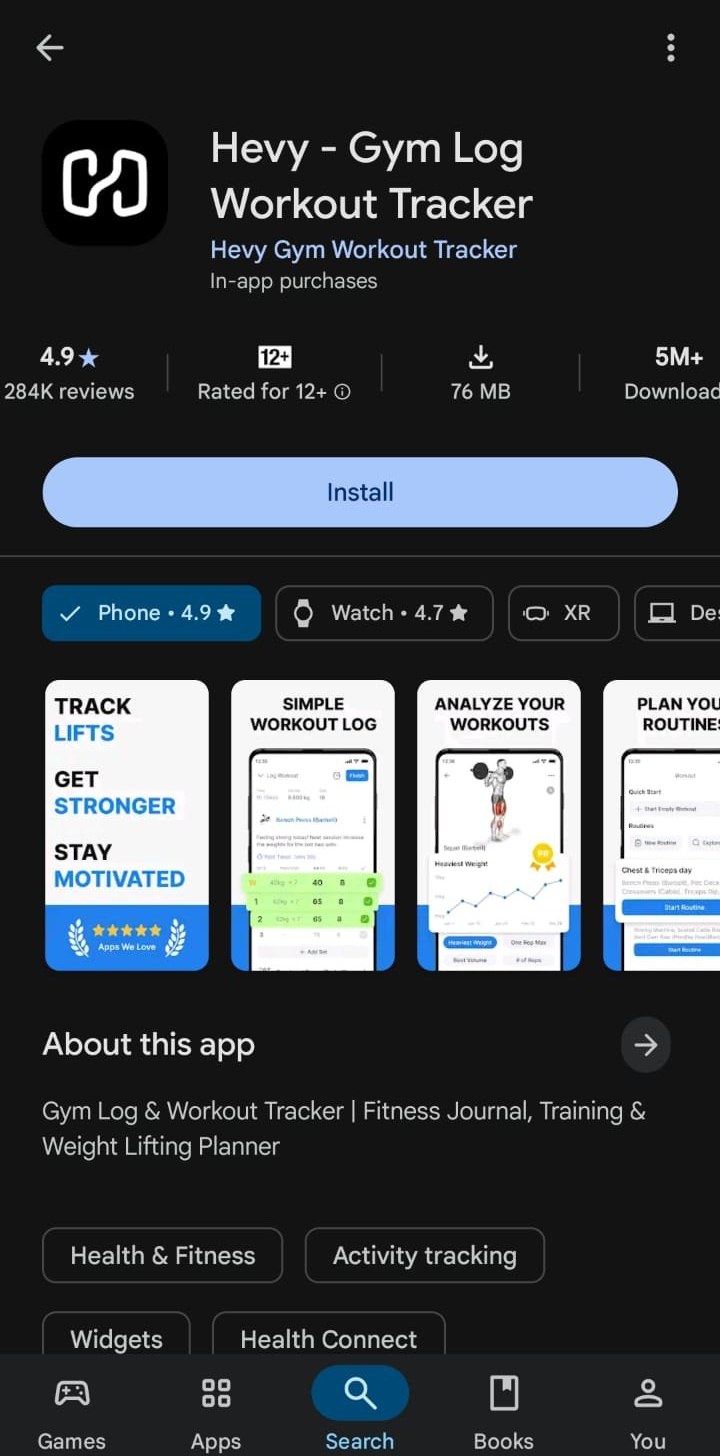
Hevy on the Play Store when I started this teardown
Hevy was started in 2019 by Guillem Ros and Desmond McNamee, two developers who lift and were frustrated with the trackers already out there. They bootstrapped it, and the idea borrows a lot from Strava: logging is the core, and your workouts also show up in a feed your friends can follow.
It's now one of the biggest apps in the category, with 15 million+ users according to its App Store listing, and 5M+ downloads and a 4.9 rating from 284K reviews on Google Play.
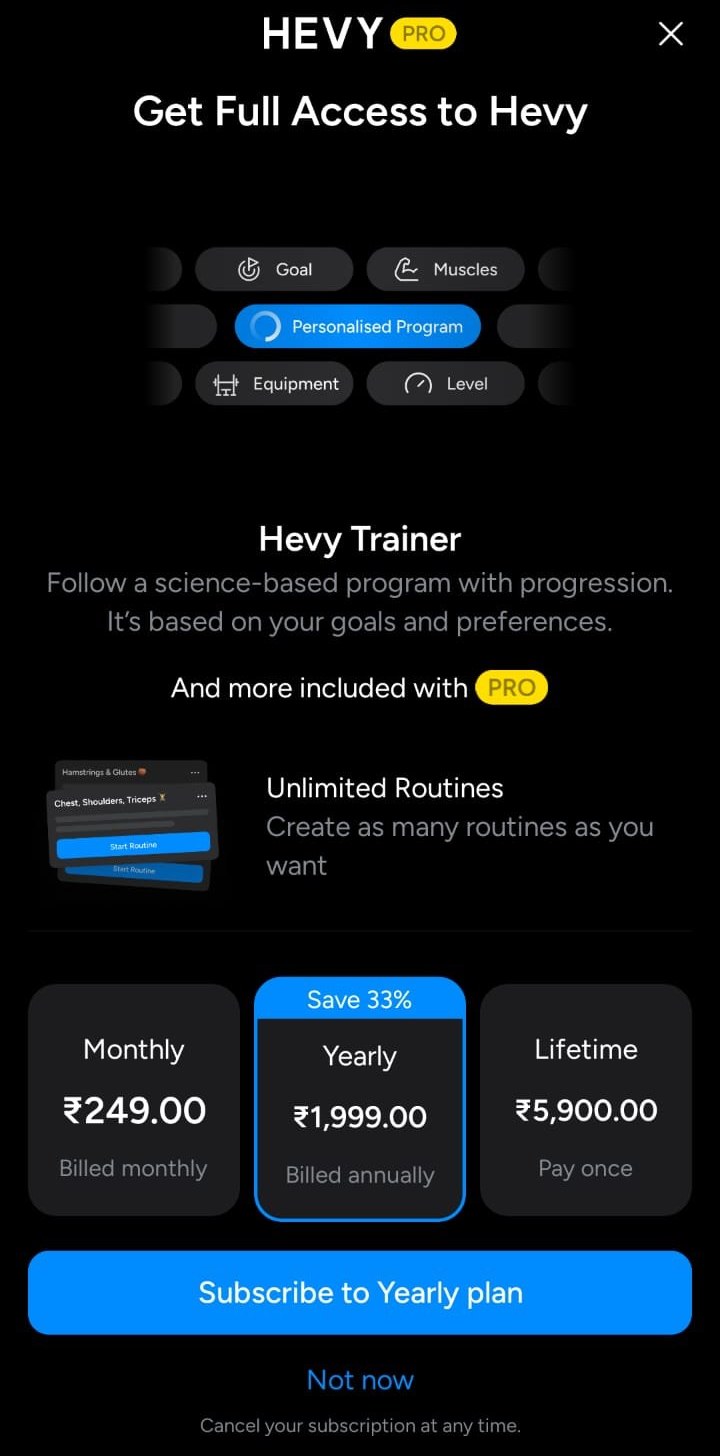
The business model is freemium. Logging is free, unlimited and has no ads. Hevy Pro costs ₹249 a month, ₹1,999 a year or ₹5,900 once for lifetime access in India. The free plan is capped at 4 routines, 7 custom exercises and 3 months of graph history.
Who it's for
I think about Hevy's users in three groups.
The beginner. Just joined a gym, wants a plan and wants to remember what they lifted last week. Hevy is close to perfect for this person, as long as their plan fits in four routines.
The regular. Six months or more in, runs their own program, cares about personal records and progress charts. Hevy works well here too, right up until they need a fifth routine or want to look back further than three months on the free plan.
The graduate. Knows their routine by heart and tracks most of it in their head. They open the app less and less, then stop. By July, this was me. Hevy has very little for this person, and most of this teardown is about them.
The first 10 minutes
I made two new accounts in November 2026 on Android to see onboarding the way a new user does. Hevy splits onboarding into two paths, and I went down both.
Intro slides (3)
Sign up
8 profile questions
Fork"Build my own" or "Be guided"
Be guided: 27 screens
6 more questions
Health disclaimer
"Preparing your program"
Your program
Trainer paywall
Not now
"Are you sure?" screen
Build my own: 17 screens
General Pro paywall (with Skip)
Email opt-in
Contact sync
"How did you hear about Hevy?"
Welcome slides (4)
Home
The three asks both paths end with: paywall, email, contacts
Tap a step to see the screens
Before you sign up
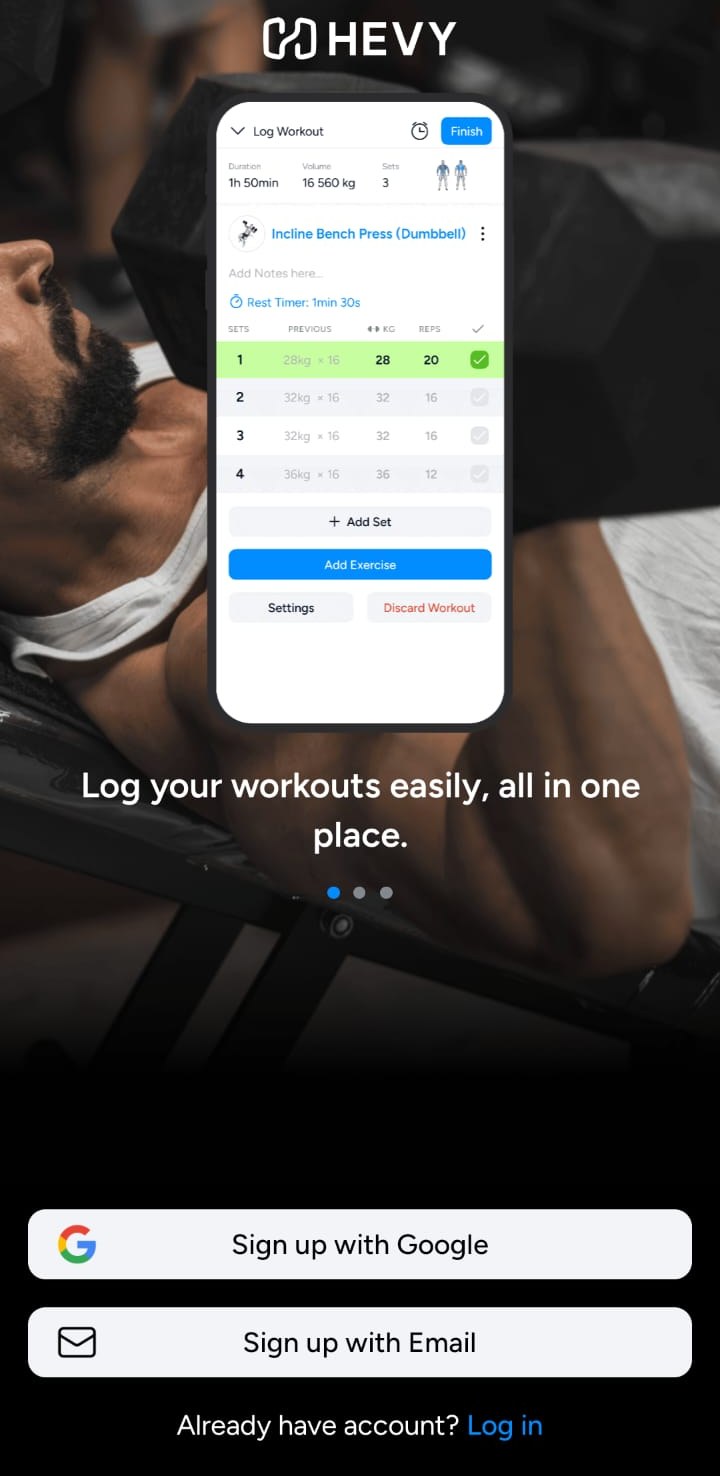
Slide 1: log your workouts
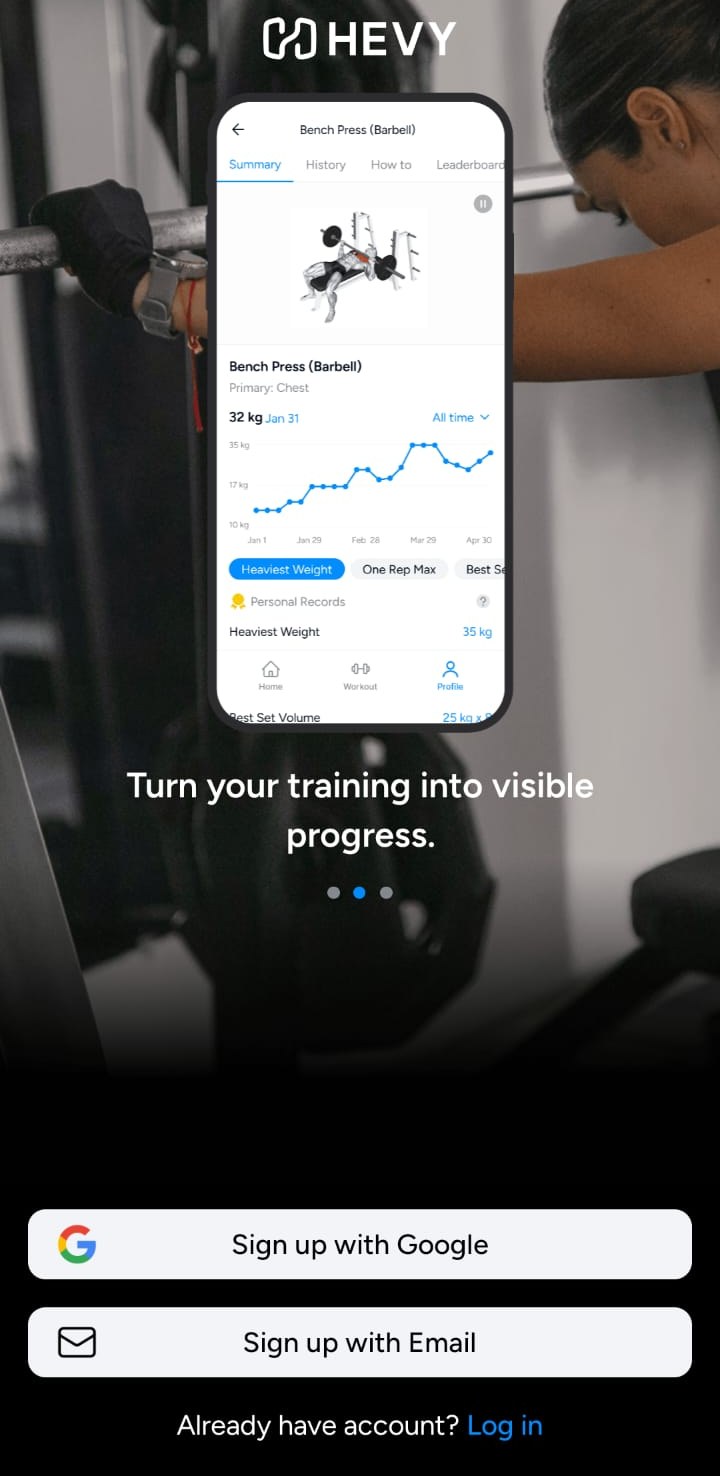
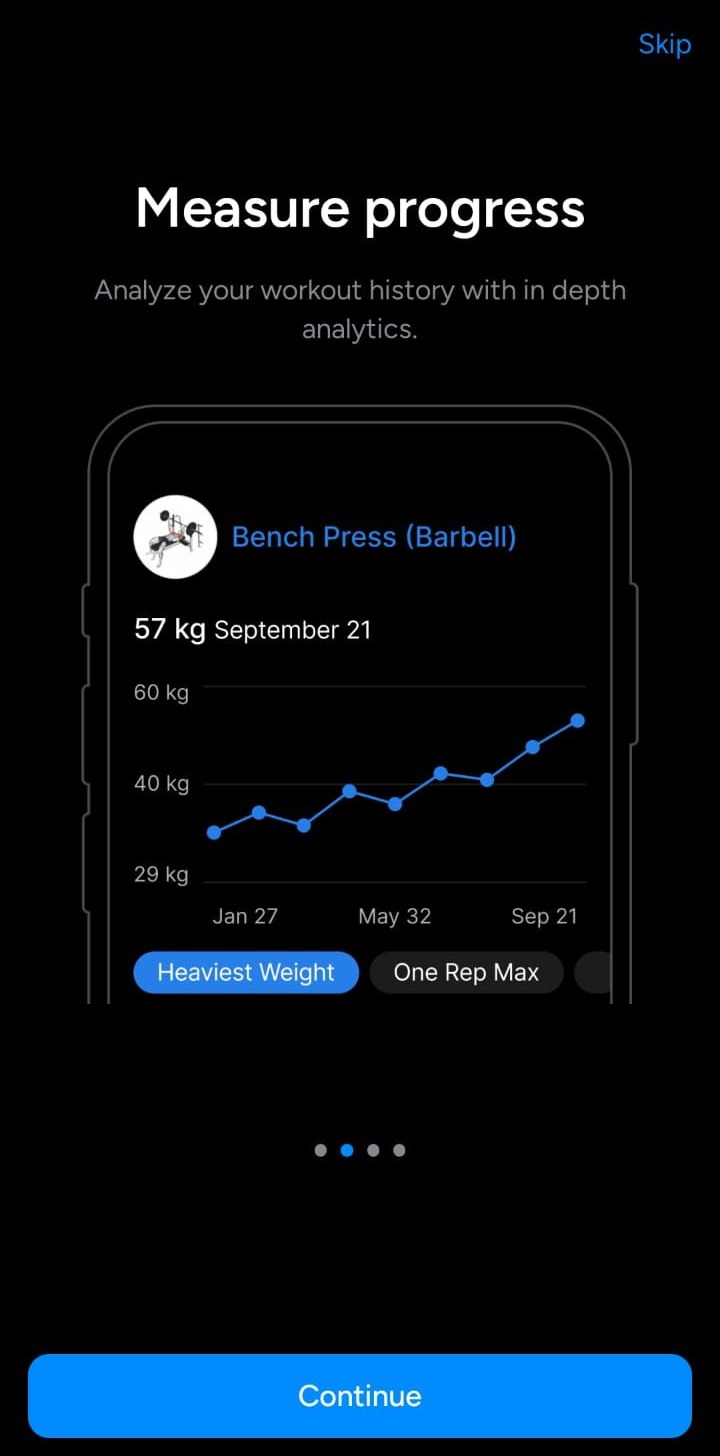
Slide 2: see your progress
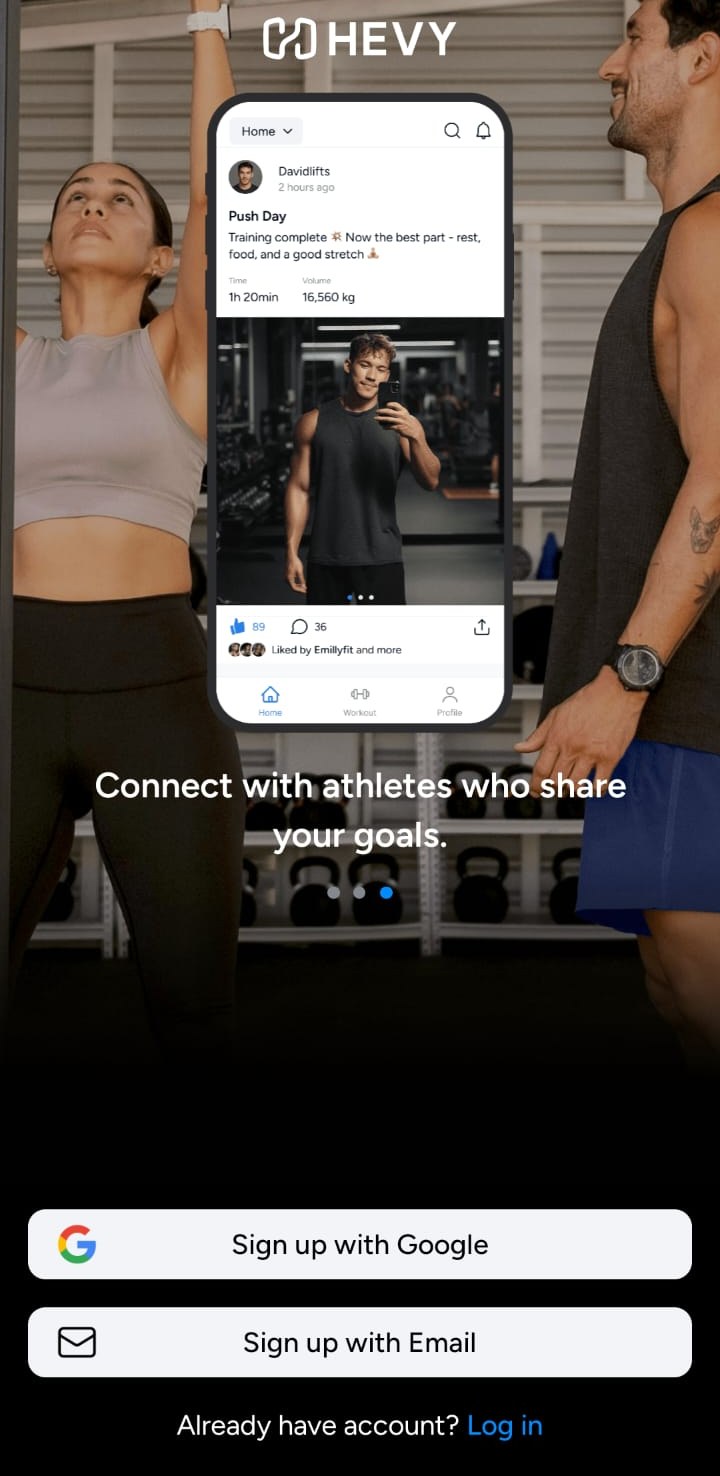
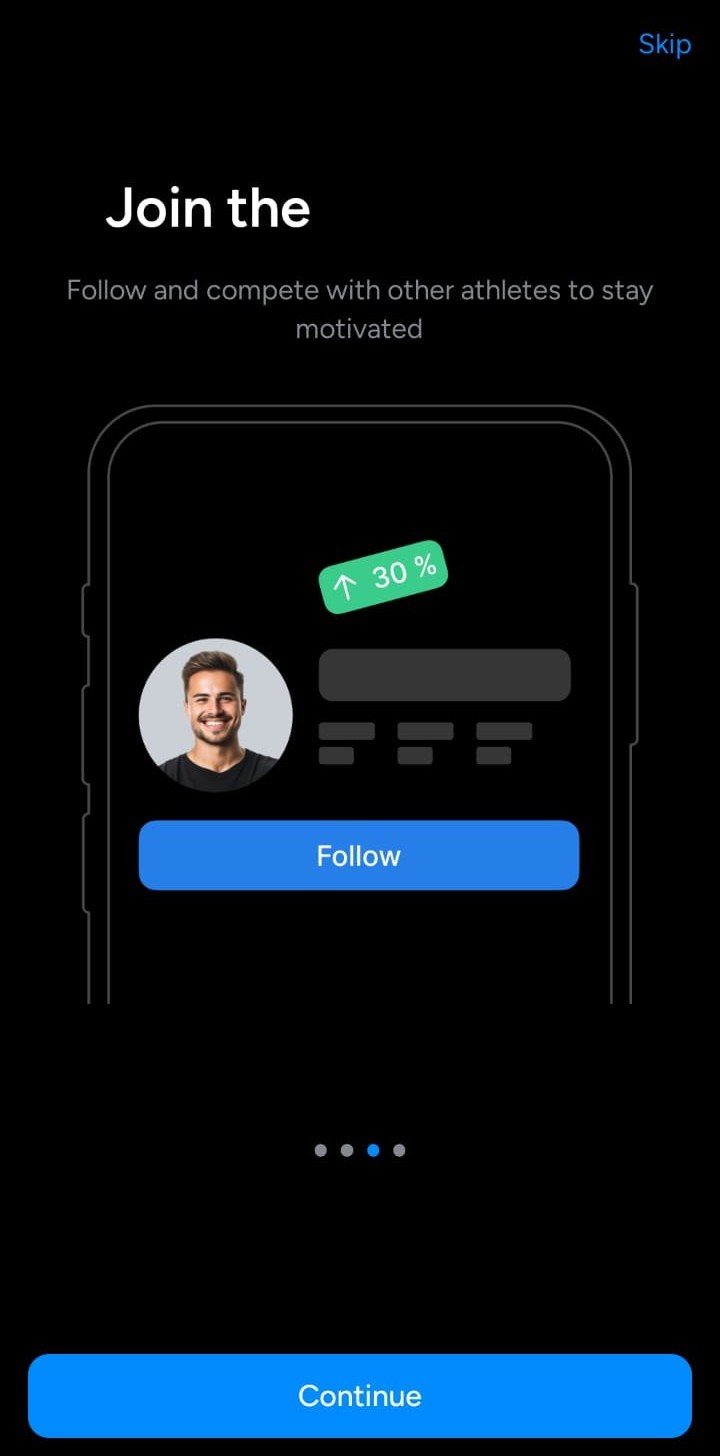
Slide 3: connect with other athletes
Three slides, in this order: log your workouts, see your progress, connect with people. That order is basically Hevy describing itself.
Path 1: "I want to be guided"
For people who want a plan made for them. Hevy asks six more questions, like how often you train, how long your sessions are and what equipment you have, then builds a program from your answers.
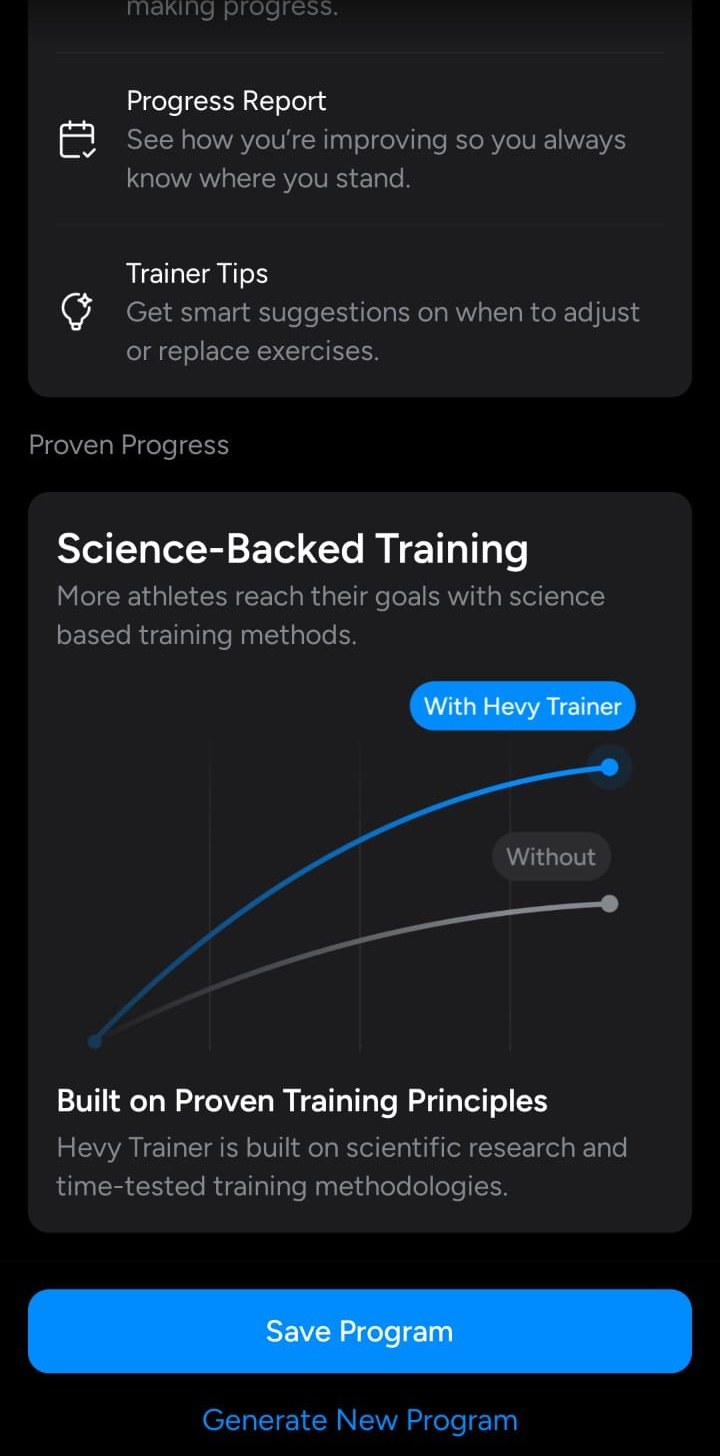
Tap Save Program and this appears
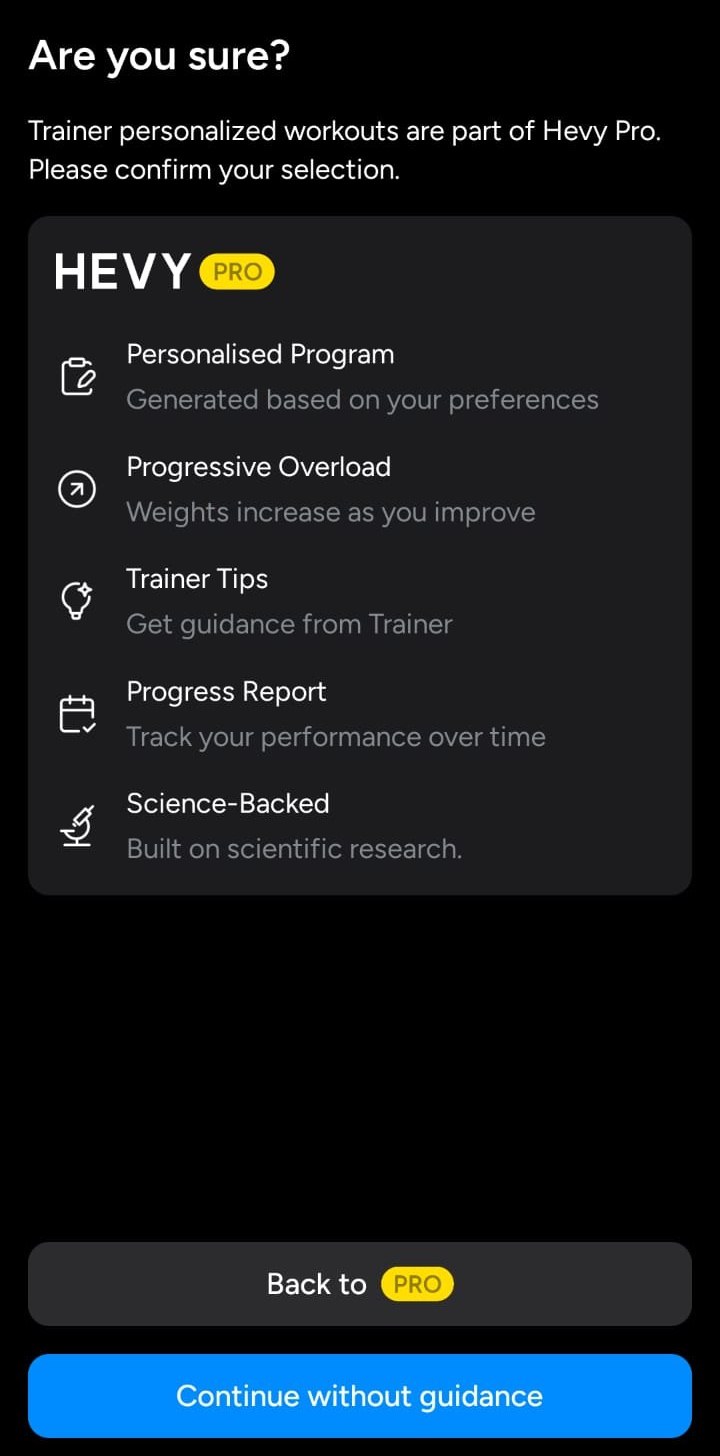
Tap Not now and you get this
Tap Save Program and you hit the paywall. The program is part of Hevy Trainer, which is Pro. If you tap Not now, you get an "Are you sure?" screen listing everything you're giving up, with Back to PRO as the top button.
From a conversion point of view this is smart. You've spent a couple of minutes describing yourself and you're looking at a plan made for you. You will never be more invested in the app than at that moment, so that's where they ask for money.
The cost is that everyone who picks "be guided" and doesn't pay learns in their first five minutes that the thing they asked for isn't free. I'd want to know how many of those people stay long enough to log a second workout.
"With Hevy Trainer" vs "Without"
There's also a chart on this screen showing your progress climbing faster with Hevy Trainer. They're selling you the outcome, not the feature.
Path 2: "I want to build my own workouts"
For people who already know what they want to do. It skips the program questions and goes straight to setting up your account.
Both paths end the same way: paywall, email, contacts, "How did you hear about Hevy?", and then a four slide welcome carousel that repeats most of what the three intro slides already said.
The paywalls are different though. On the build-your-own path there's a Skip and a Not now, and nothing pushes back if you decline. On the guided path there's the "Are you sure?" screen. Hevy pushes harder on the people who have just put effort into a plan, which makes sense if you're optimising for conversion.
Landing
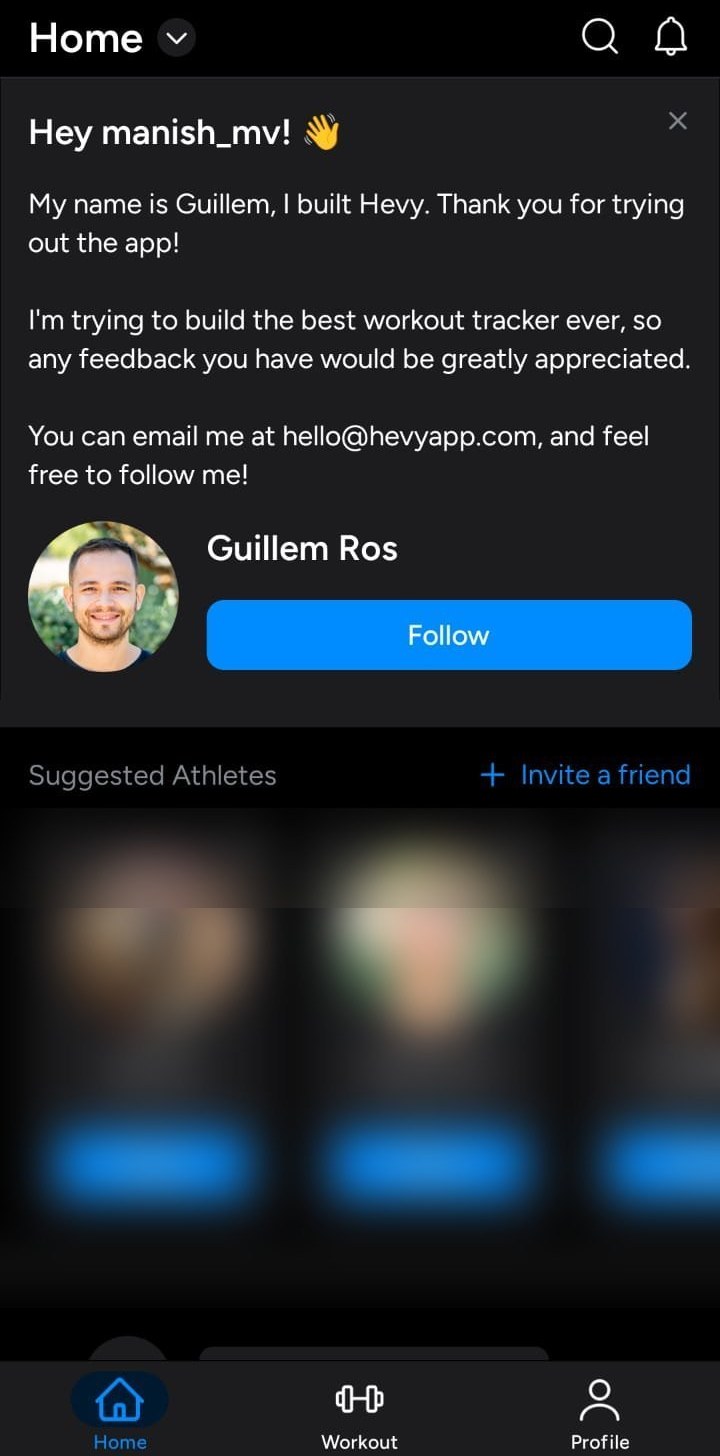
First thing on the home screen: a note from the founder
The first thing on the home screen is a note from Guillem, the founder, saying he built Hevy, asking for feedback and giving his email. I really liked this. After 20-odd screens of questions and asks, it's the first thing that feels like a person made it.
The core loop: logging a workout
This is where Hevy is at its best, and it deserves the credit.
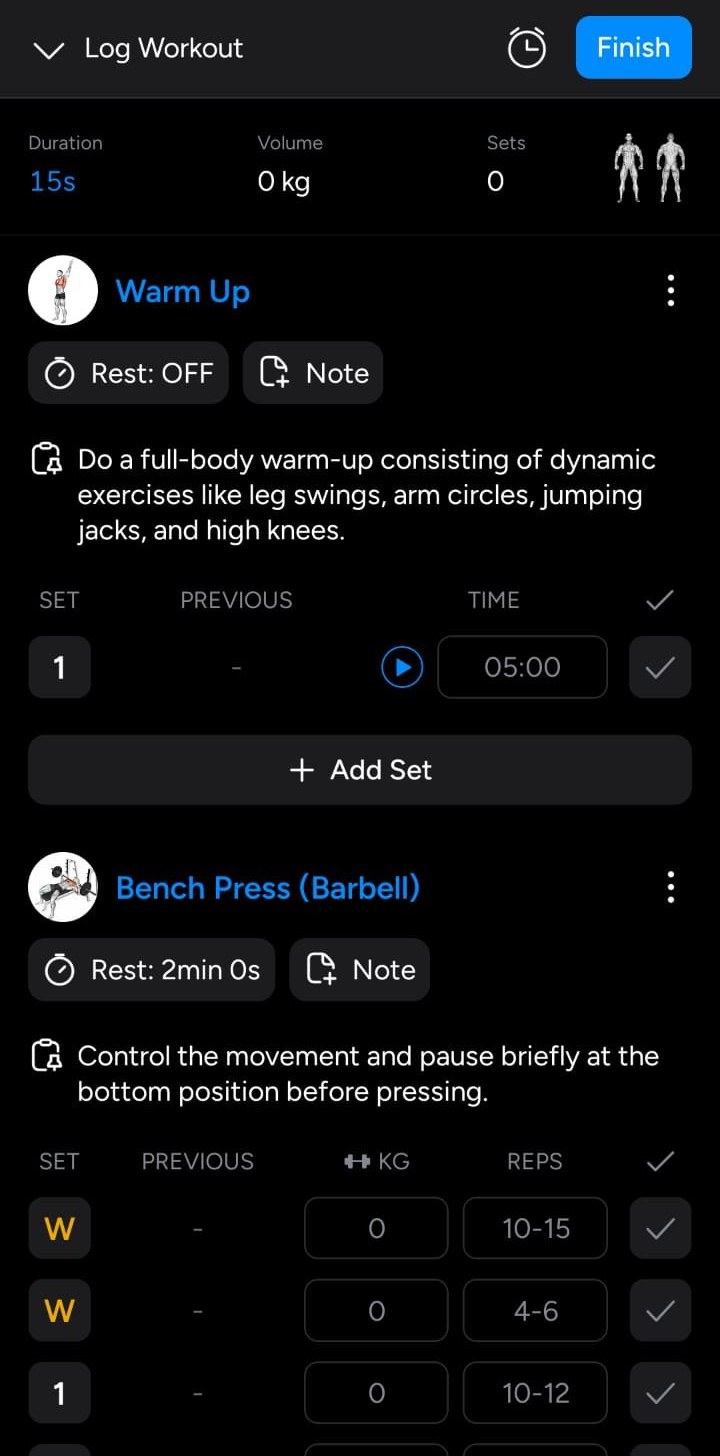
A routine in progress, with planned reps for each set
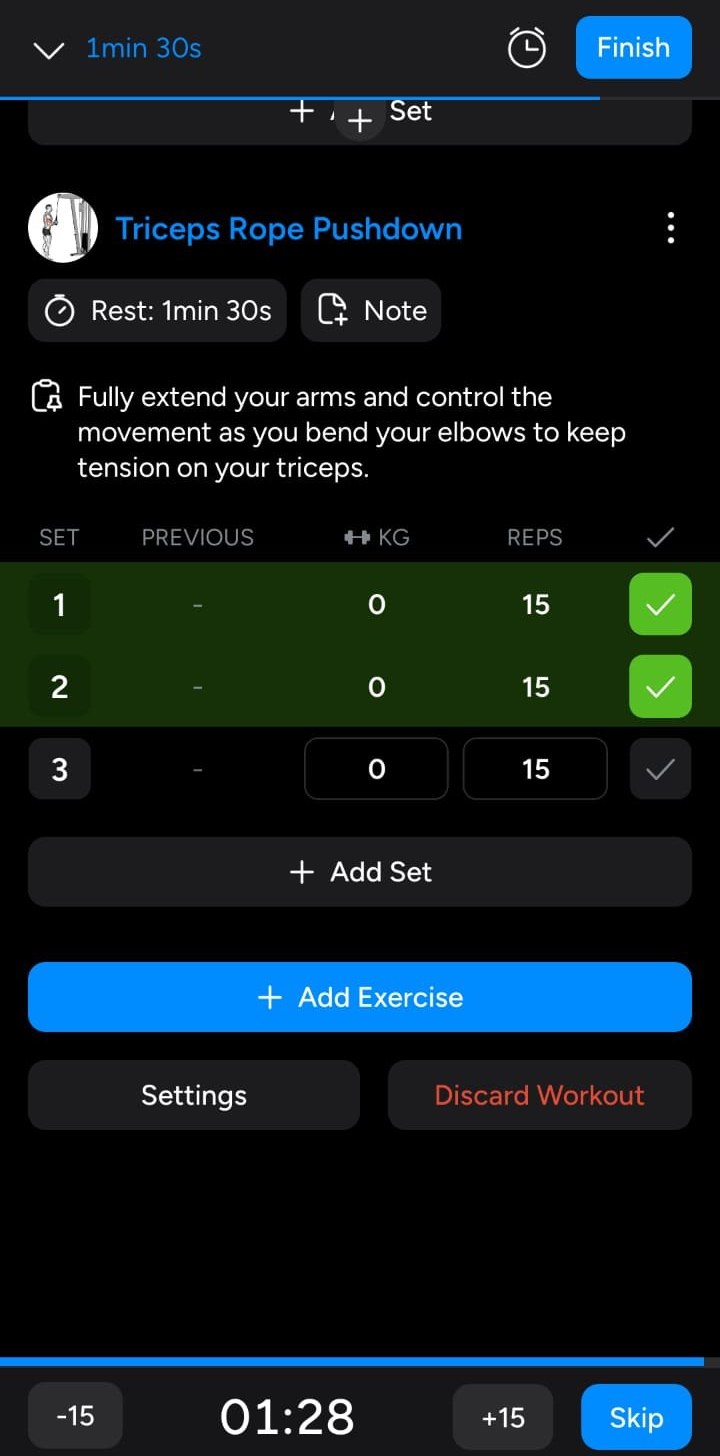
Rest timer starts on its own when you tick a set
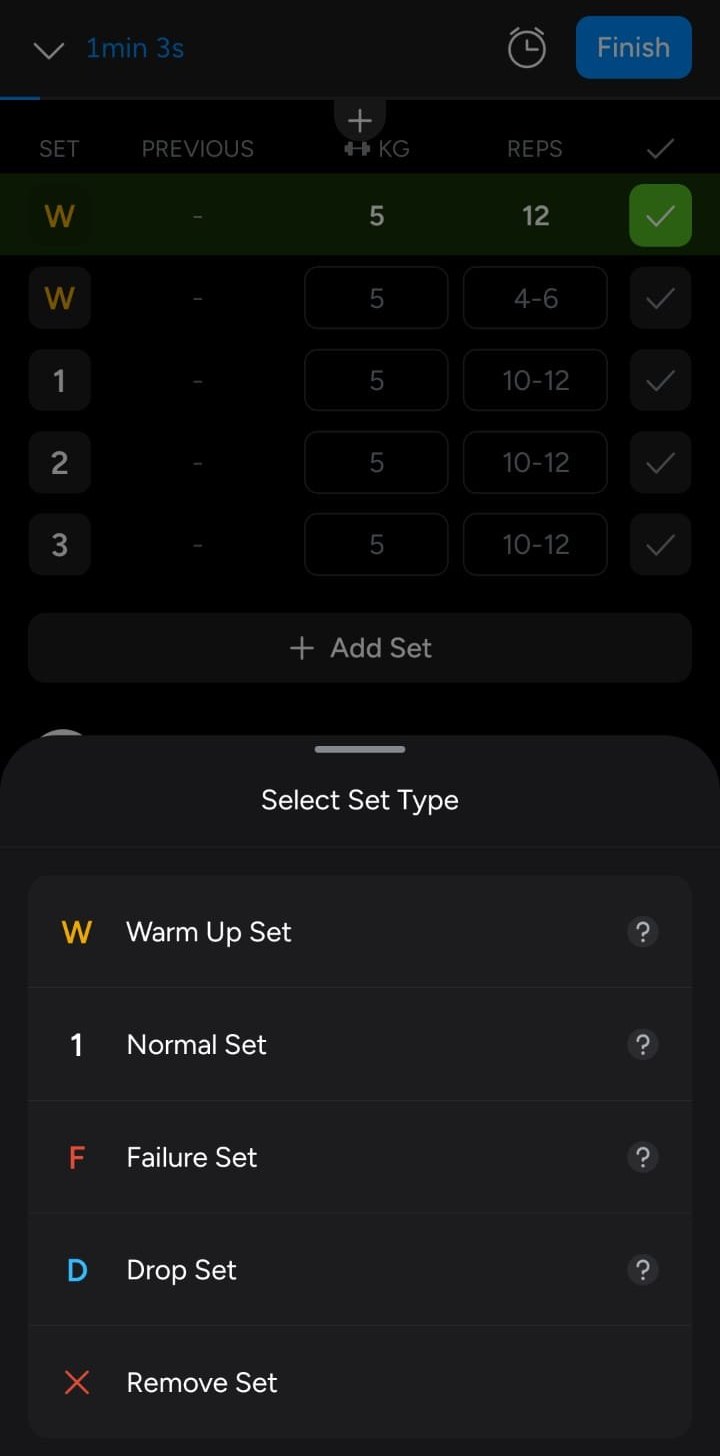
Warm up, normal, failure and drop sets
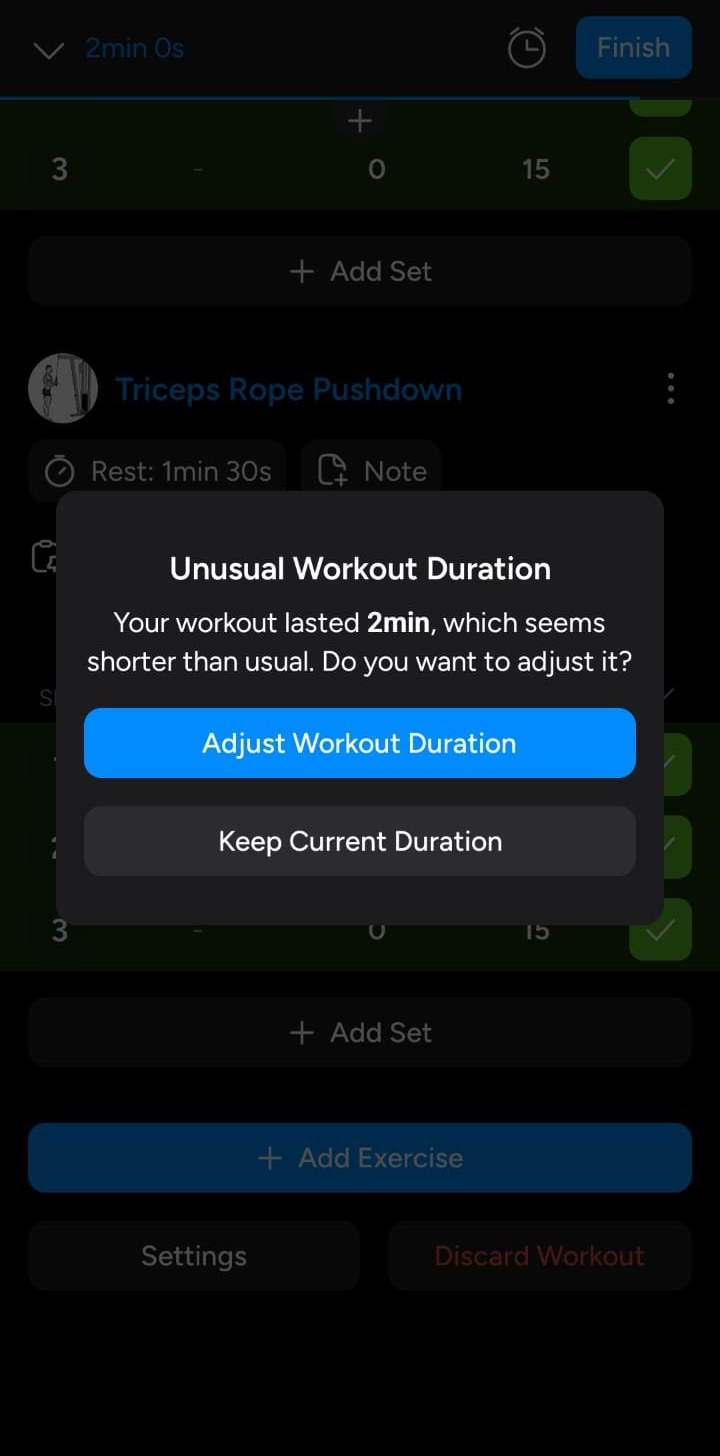
It noticed my test workout only lasted 2 minutes
You start a routine and every exercise is laid out with its sets. Your previous numbers show up in each row, so you know what to beat. Tick a set and the rest timer starts on its own, with buttons to add or remove 15 seconds.
My favourite detail: I finished a test workout two minutes after starting it, and Hevy asked whether the duration was right and offered to fix it. Most people forget to start or stop a timer at some point, and this catches it before your stats get messed up.
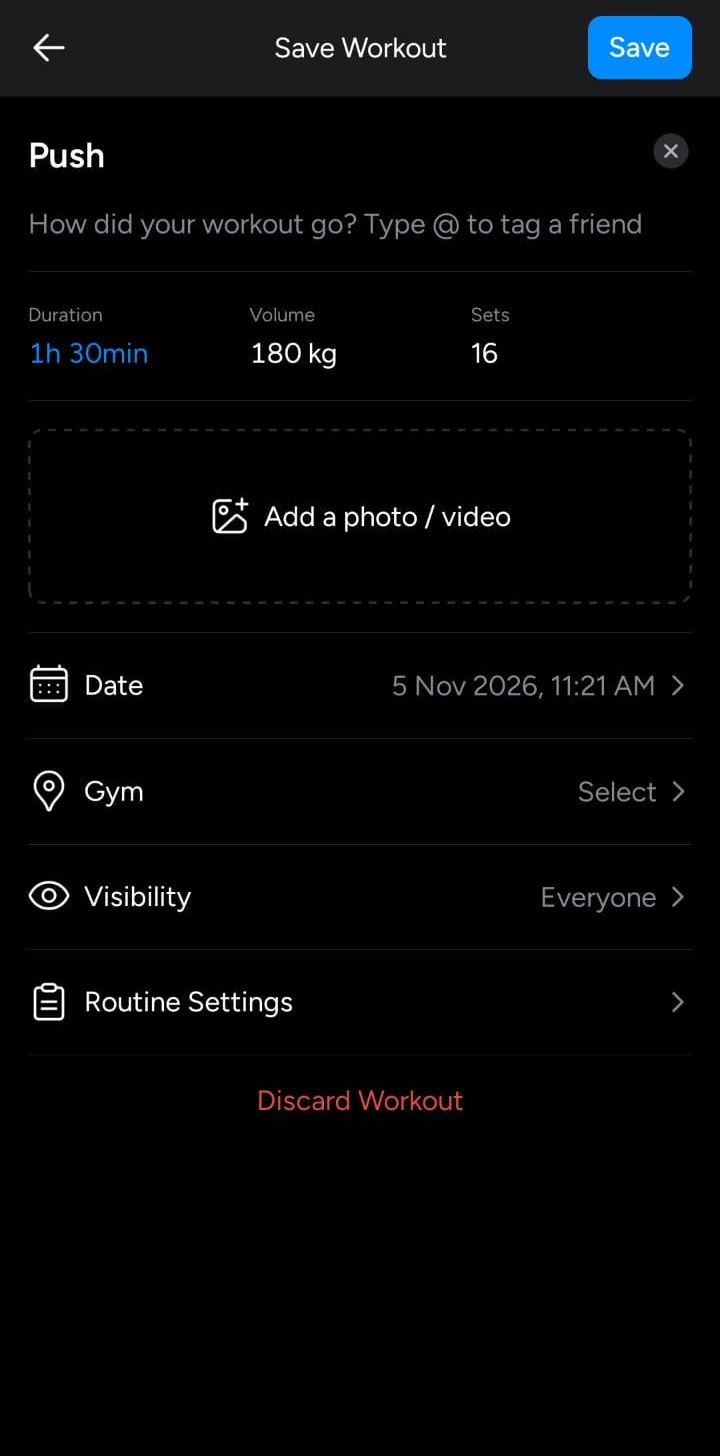
Saving: notes, photo, gym, visibility
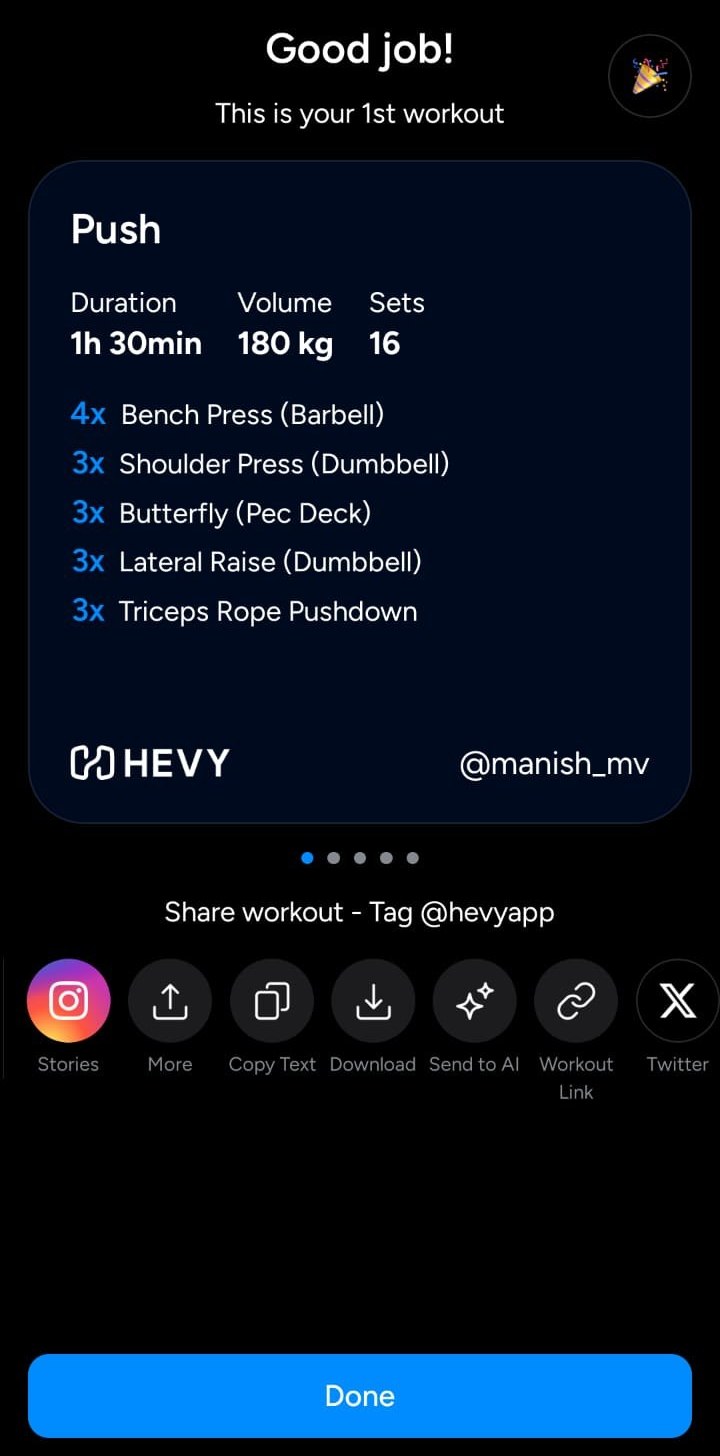
The share card after my first workout
After you finish, you get a summary and a share card for Instagram stories, with an option to send the workout to an AI app. Workouts are public by default. Shares are a big part of how Hevy grows.
The friction shows up once you know what you're doing. Every set is still a tap, plus edits whenever your numbers change. A push day for me was six exercises at around three sets each, so roughly 18 to 20 sets, and each one meant picking up my phone, finding the row and ticking it.
Reviewers feel it too. One gave Hevy one star partly because there was no Next button to jump between fields while logging. Another pointed out that for barbell lifts you have to add up the bar and the plates on both sides yourself, instead of just entering what's on one side.
Hevy clearly heard this. In a recent update they built their own workout keyboard, with plus and minus buttons to adjust numbers and an arrow that moves to the next field and completes the set. It makes each set quicker to log. You still log every set though, which is the part that wears you down after a few months.
None of this matters much in your first month, because the app is teaching you things. By month three, you're doing the same 20 taps to record numbers you already know.
Where Pro shows up
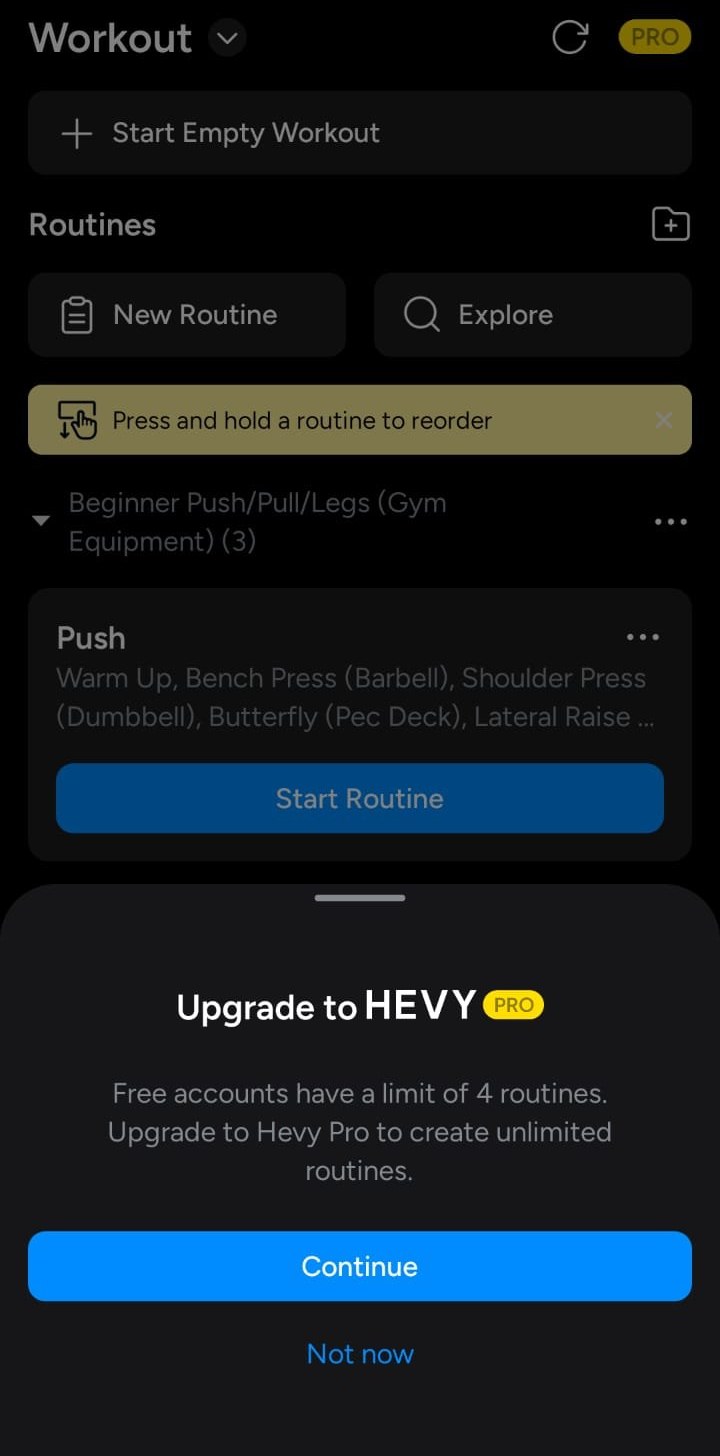
Trying to add a fifth routine
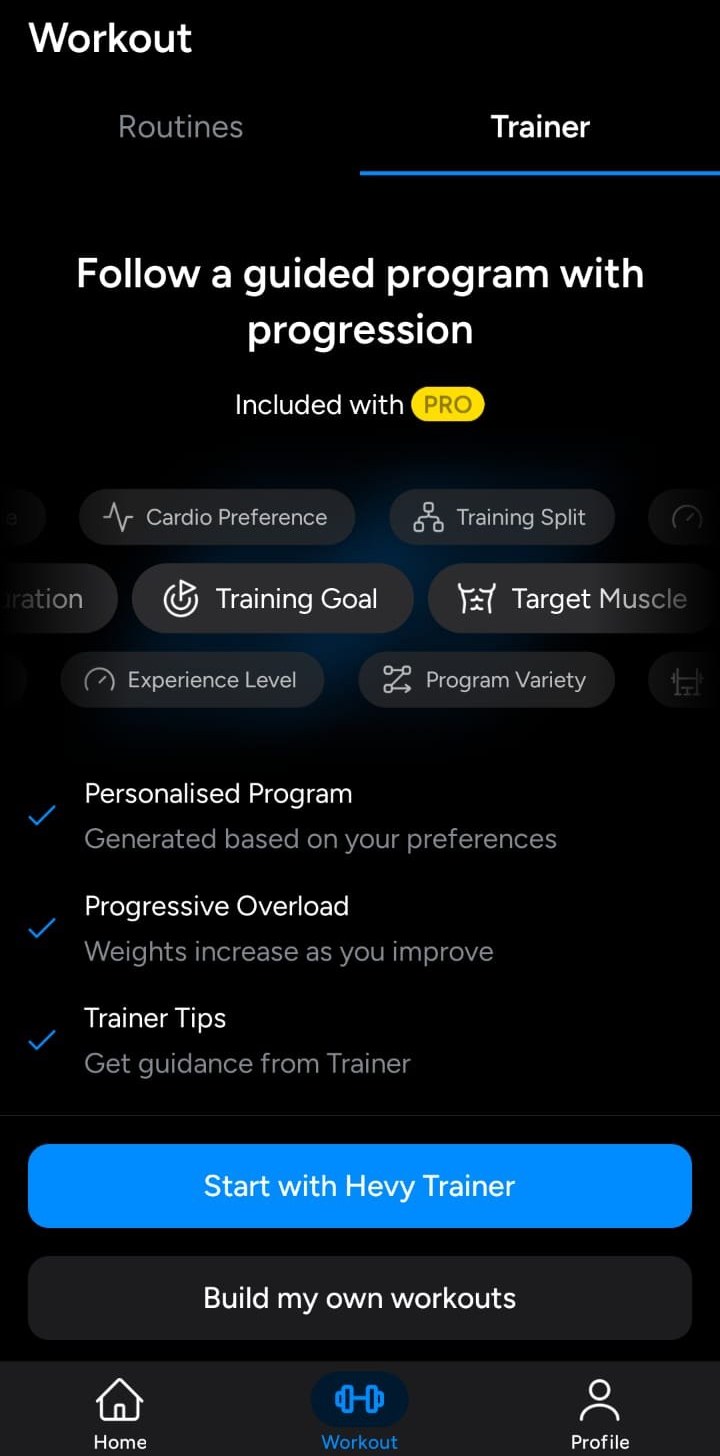
The Trainer tab
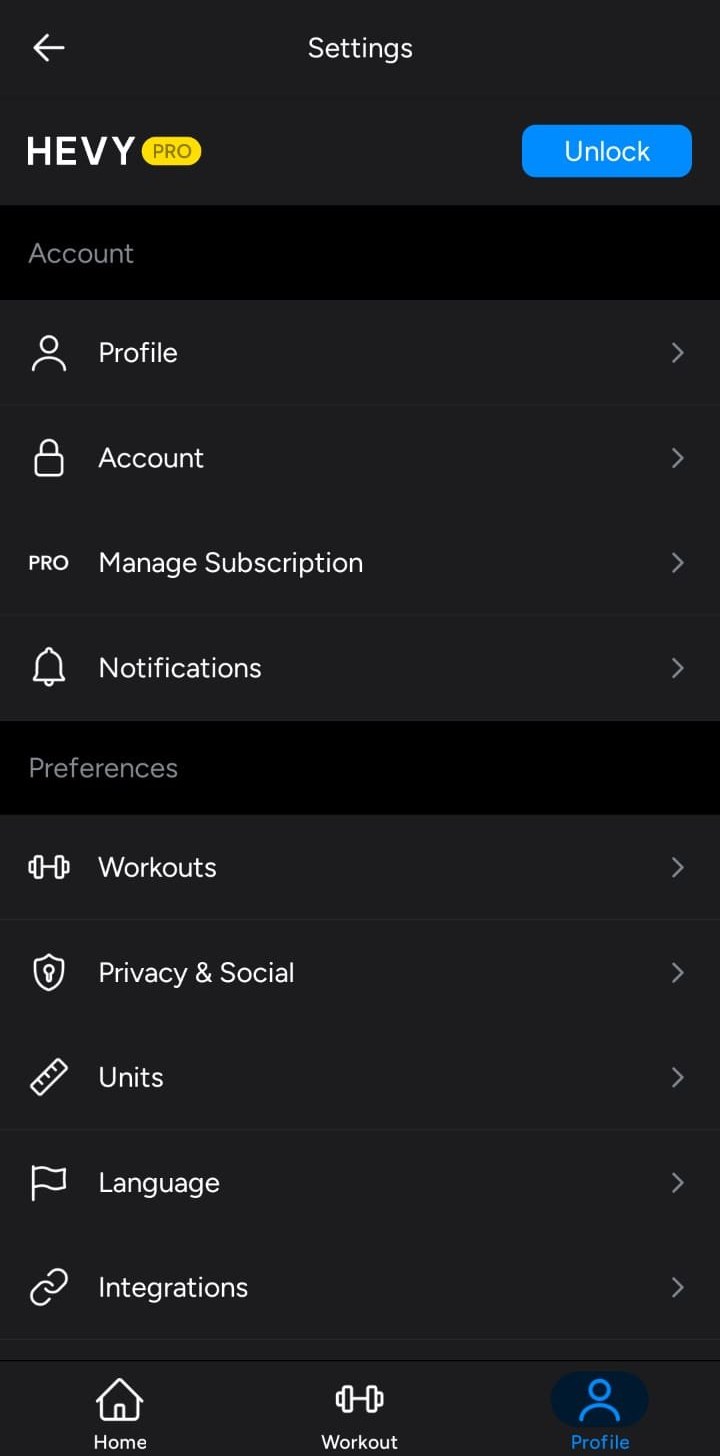
Unlock, at the top of Settings
Pro appears in quite a few places: both onboarding paywalls, a yellow PRO badge on the Workout tab, the Trainer tab, an Unlock button at the top of Settings, a PRO tag on the warm-up calculator, and a sheet that appears when you try to save a fifth routine.
The free plan limits are 4 routines, 7 custom exercises and 3 months of graph history.
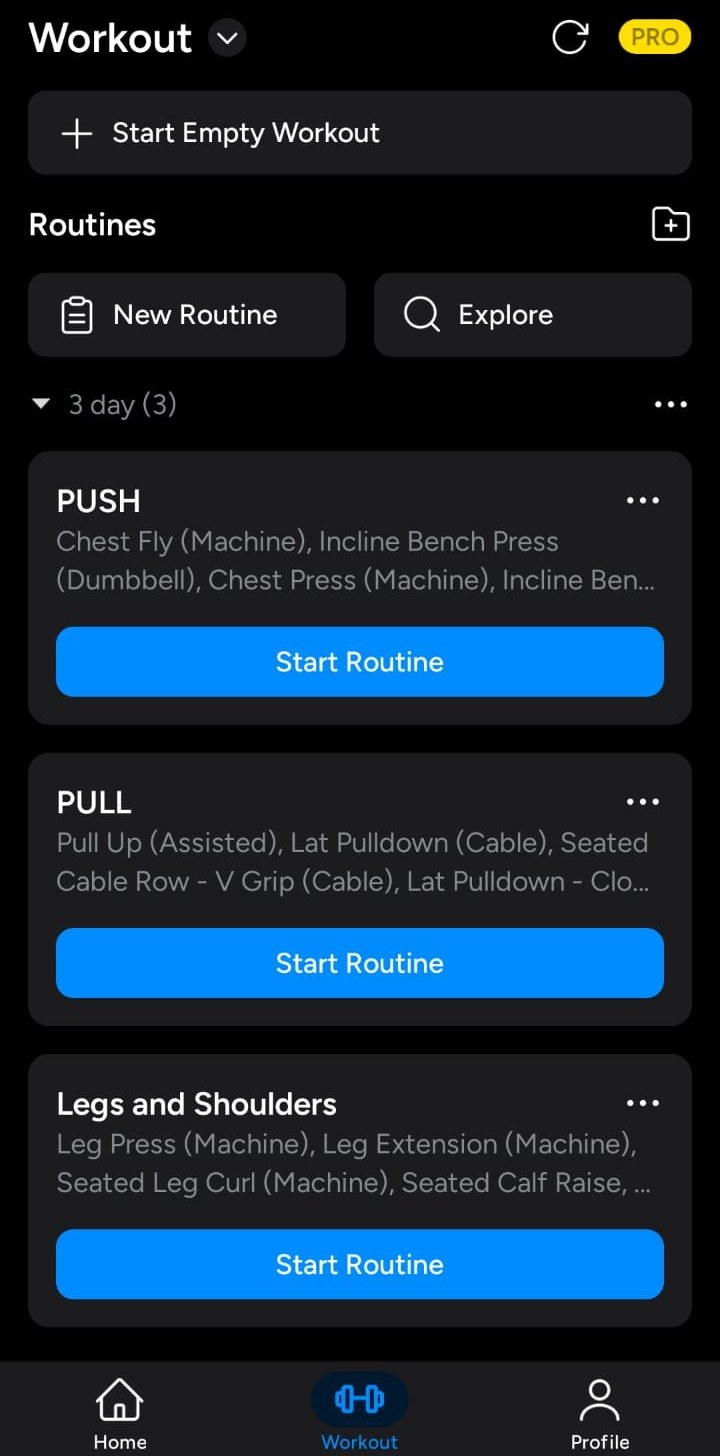
My old account: Push, Pull, Legs and Shoulders...
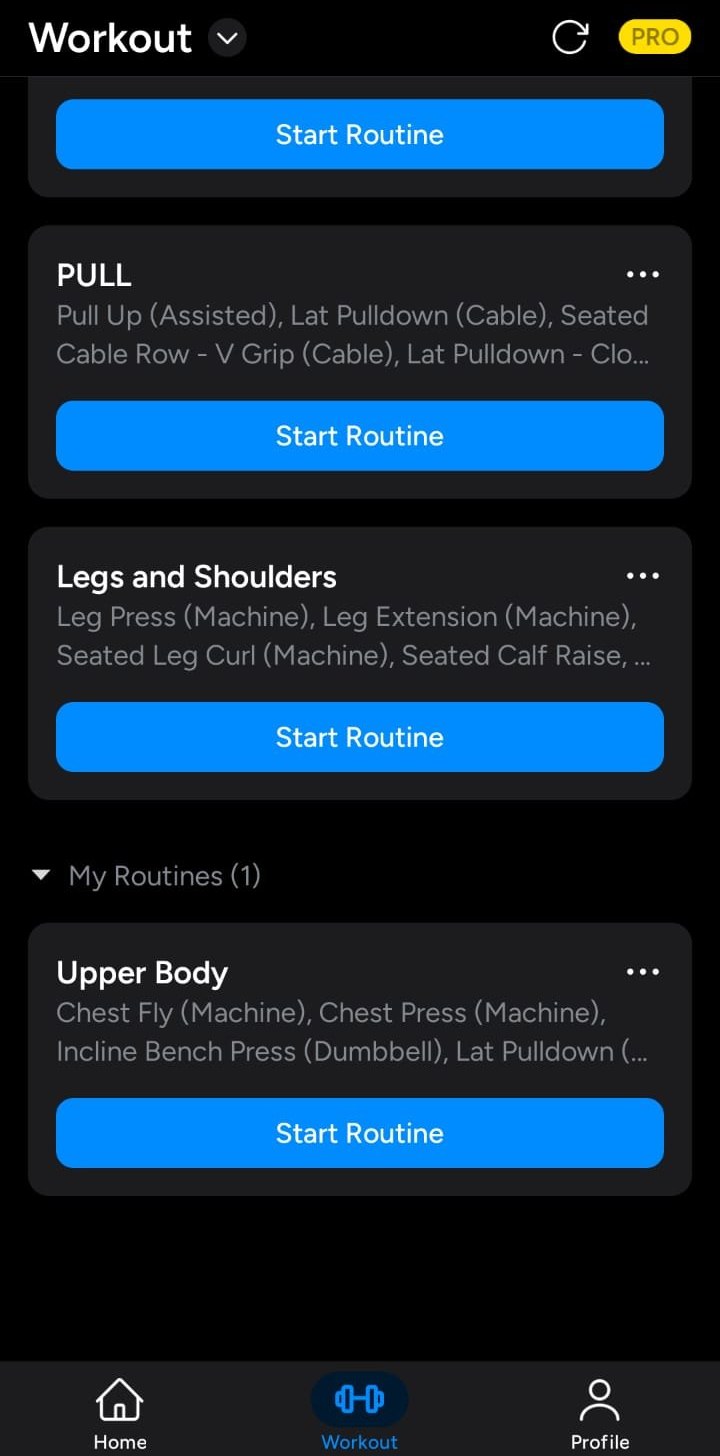
...and Upper Body. Four routines, the free limit
My old account had exactly four: Push, Pull, Legs and Shoulders, and Upper Body. Adding a lower body day for my Upper/Lower weeks would have meant paying.
I'm not against the paywall. ₹1,999 a year is very little next to a gym membership, and reviews show plenty of people happily upgrading to get more routines. The cap clearly works.
My concern is where it lands. In my year of training, I've noticed a lot of beginners start on a bro split: one muscle group a day, six different workouts. That's two more than the free plan allows, so they hit the paywall in their first week, before the app has had a chance to become a habit. Anyone who doesn't pay ends up deleting and rebuilding routines, or cramming two days into one, which is exactly the kind of friction that makes people stop logging.
Social and comparison
Home has two feeds: Following and Discover
Comparing my profile with another user
Home is a feed of people you follow, with a Discover feed one tap away and suggested athletes underneath. You can open anyone's profile and hit Compare.
I like this feature. Comparing with a friend who trains at the same gym turns logging into a bit of friendly competition: who's been more consistent this month, whose bench has moved more. It gives you a reason to open the app that isn't just recording a set, and every comparison is another nudge to follow people, which feeds the social loop Hevy grows on.
Hevy has also added Gym Profiles, with your gym's workout feed and a leaderboard for each exercise. That takes the same friendly competition beyond your friends list, to the people you actually train next to.
The social side splits users. Some reviewers say the community is their favourite part of Hevy, others say they never touch it, and one wished the app didn't open on the social feed by default. Hevy is built around social, so I don't think it should go anywhere. I'd just let people choose whether the app opens on the feed or on their workouts.
The graduation problem
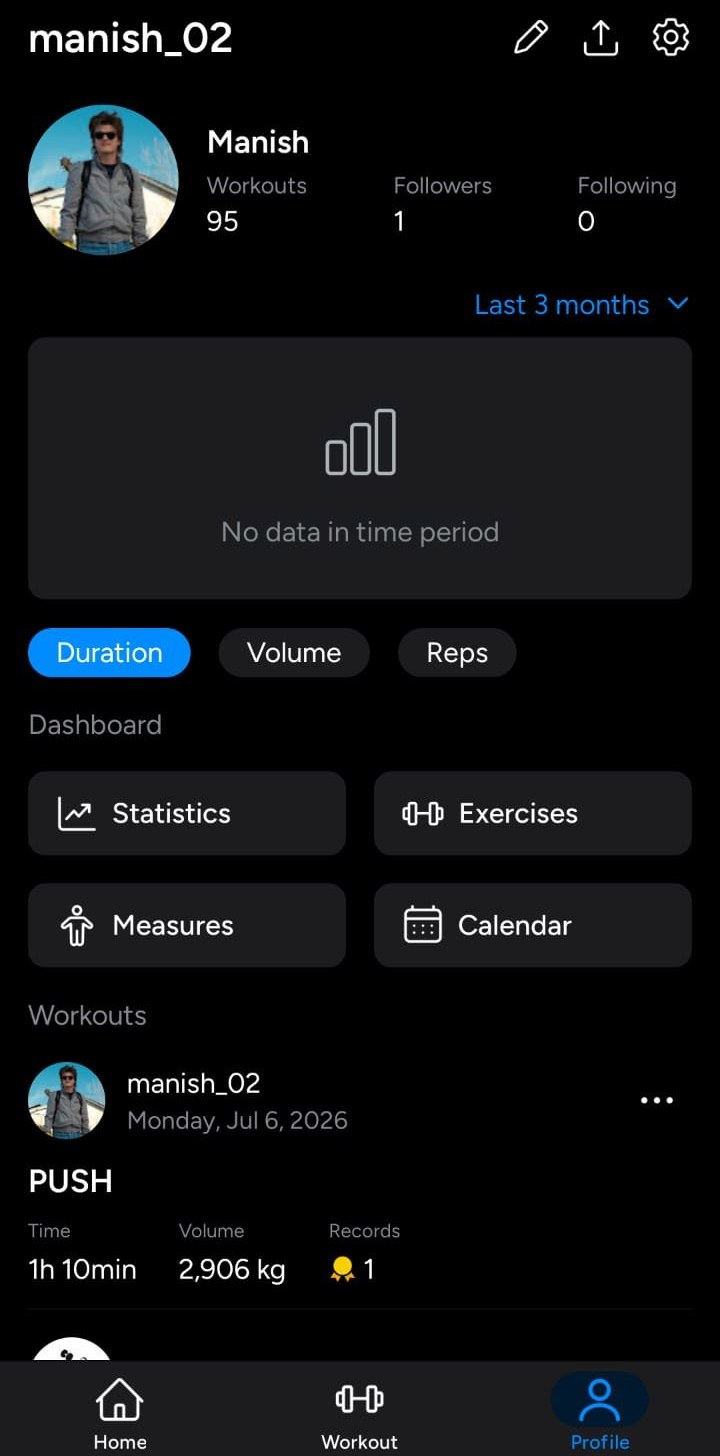
My old profile: 95 workouts, and an empty chart for the last 3 months
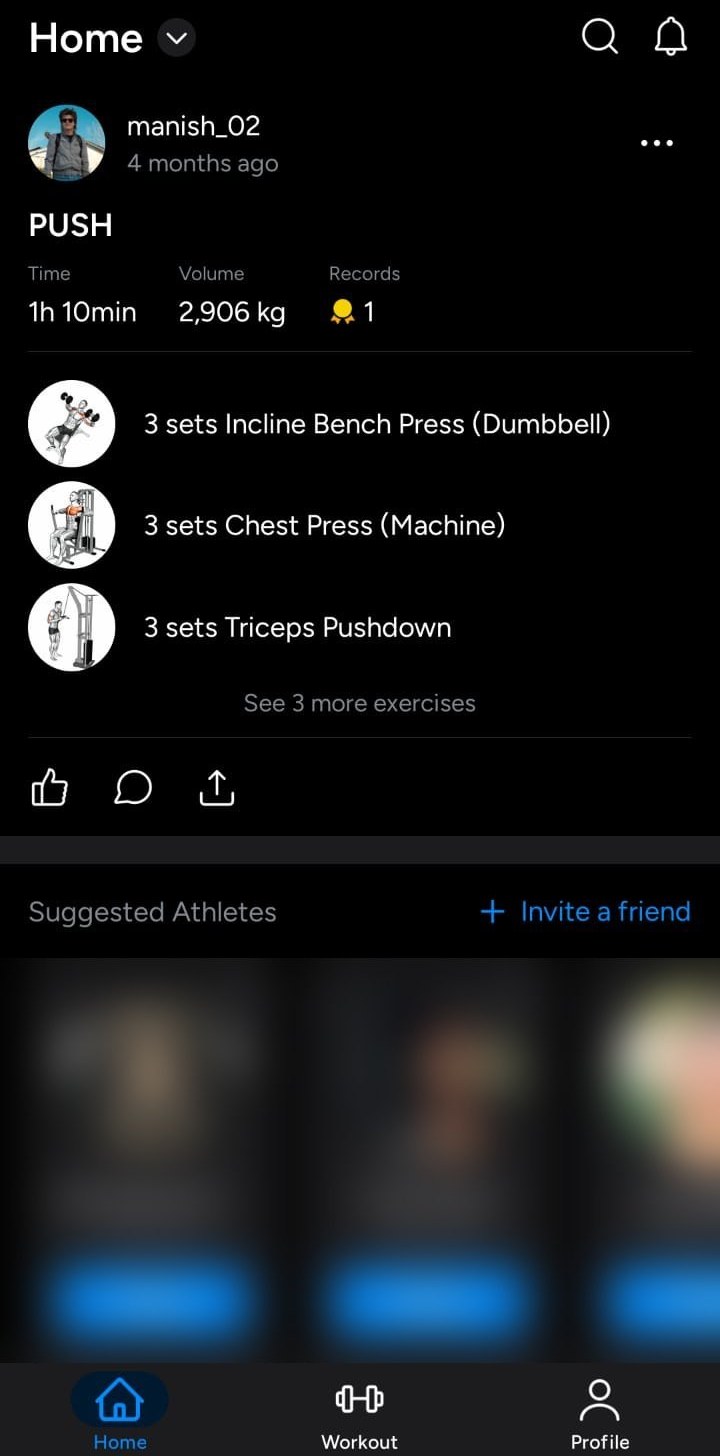
My old home feed: my own workout from 4 months ago
What happened
In the four months since my last workout, nothing from the app tried to get me back. Hevy does track streaks, so it notices when you're consistent. It just has nothing to say once a streak breaks.
Why I stopped
I came to Hevy to build a routine, stay consistent, and check my rest and progressive overload (adding a bit more weight or reps over time).
After a couple of months I had a handle on all of it, so logging every set felt like more effort than it gave back. I started tracking in my head.
Then my plan grew to five different workouts, and the free plan only saves four.
It's not just me
25 workouts in, one reviewer said after a week or two your routine is "pretty memorized anyhow."
One keeps a separate journal to know when to deload (take a planned lighter week), because Hevy gives no overview of a training block.
Another wanted the app to handle progressive overload automatically.
A lifter with ten years of training asked if Hevy would ever help with weak points.
Every one of those is asking the app to tell them something about their training, which is a different job from recording it.
What I'd build
Six ideas, grouped by the problem each one solves. I don't have Hevy's data, so the metrics are what I'd watch, not numbers I know.
Logging takes too much effort
1
Quick log for routines you know
Problem
by month three, logging a routine means 20 or so taps to record numbers you already knew.
Idea
add a "Log as planned" button on each exercise that ticks every set at the planned or previous values in one go, so you only touch the sets that went differently.
What I'd measure
taps per logged set, and the share of users still logging at least once a week in weeks 9 to 12.
2
Log by voice
Problem
even with the new keyboard, you still pick up your phone, unlock it and type between every set.
Idea
say your set out loud, like "incline dumbbell 24 kg, 10 10 8", and Hevy turns it into sets. The speech part can run on the phone and the parsing can be rule-based, so it stays free and fits Hevy's no-AI approach.
What I'd measure
share of sets logged by voice, and time between finishing a set and logging it.
Experienced lifters need more from the app
3
Plateau alerts
Problem
the monthly report tells you what you did. It won't tell you a lift has been stuck for a month.
Idea
when a lift hasn't moved in four sessions, flag it during the workout with one suggestion: change the rep range, swap the variation or take a deload week. Rule-based, same as Trainer.
What I'd measure
share of flagged lifts that improve within four weeks, and logging retention for users past 50 workouts.
4
Milestone stories
Problem
Year in Review is great, but it only comes in December. People like me drift off around month three.
Idea
at workout 50 or month three, show a short Wrapped-style story putting your first session next to today on each main lift, with full history unlocked for that story.
What I'd measure
share rate, and logging in the four weeks after seeing the story compared with users who haven't seen it yet.
Staying connected
5
Gym leaderboards
Idea
borrow Strava's Local Legends. Rank people at the same gym by sessions in the last 90 days and show where you sit on a histogram. It makes a fun, friendly competition with the people at your gym, and a beginner can compete on consistency from week one.
What I'd measure
workouts per week at gyms with a leaderboard, and the share of users who tag their gym.
6
Lapsed user check-in
Problem
when someone stops logging, Hevy can't tell if they stopped training, got injured or just stopped logging.
Idea
after 3 to 4 weeks with no workout, send one question by push notification and email: stopped training, stopped logging, injured, taking a break or found a better app. Each answer gets its own next step, like Trainer's injury setting for injuries or "Log as planned" for people still training. Anyone who comes back gets 10 days of Pro free when they log their next workout.
What I'd measure
response rate by channel, the share of responders who log again within two weeks, and the split of answers.
Small things I noticed
None of these are big, but they're the kind of thing I'd file as tickets.
One of the welcome slides has a headline that just says "Join the" and stops.
A sample progress chart on another welcome slide has "May 32" on its x axis.
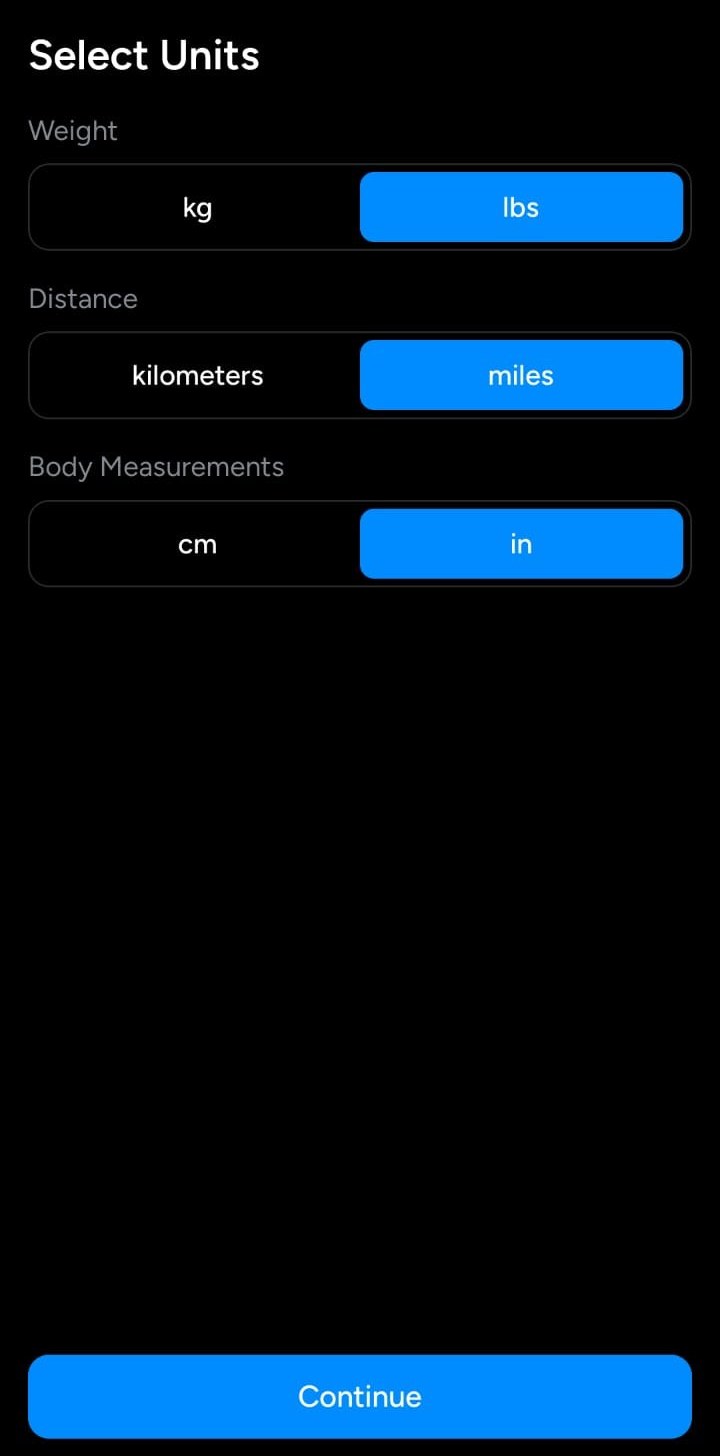
Units default to lbs and miles for a user signing up from India.
How I did this
For this teardown I made two new accounts on Android in November 2026, went down both onboarding paths, logged a test workout, and read Hevy's help centre, store listings and App Store reviews. It's still one person's view, without Hevy's data, so treat what's here as hypotheses I'd want to test.
Social and comparison
Home is a feed of people you follow, with a Discover feed one tap away and suggested athletes underneath. You can open anyone's profile and hit Compare.
I like this feature. Comparing with a friend who trains at the same gym turns logging into a bit of friendly competition: who's been more consistent this month, whose bench has moved more. It gives you a reason to open the app that isn't just recording a set, and every comparison is another nudge to follow people, which feeds the social loop Hevy grows on.
Hevy has also added Gym Profiles, with your gym's workout feed and a leaderboard for each exercise. That takes the same friendly competition beyond your friends list, to the people you actually train next to.
The social side splits users. Some reviewers say the community is their favourite part of Hevy, others say they never touch it, and one wished the app didn't open on the social feed by default. Hevy is built around social, so I don't think it should go anywhere. I'd just let people choose whether the app opens on the feed or on their workouts.